Italian Grammar Printables: What to Print and Keep on Your Desk
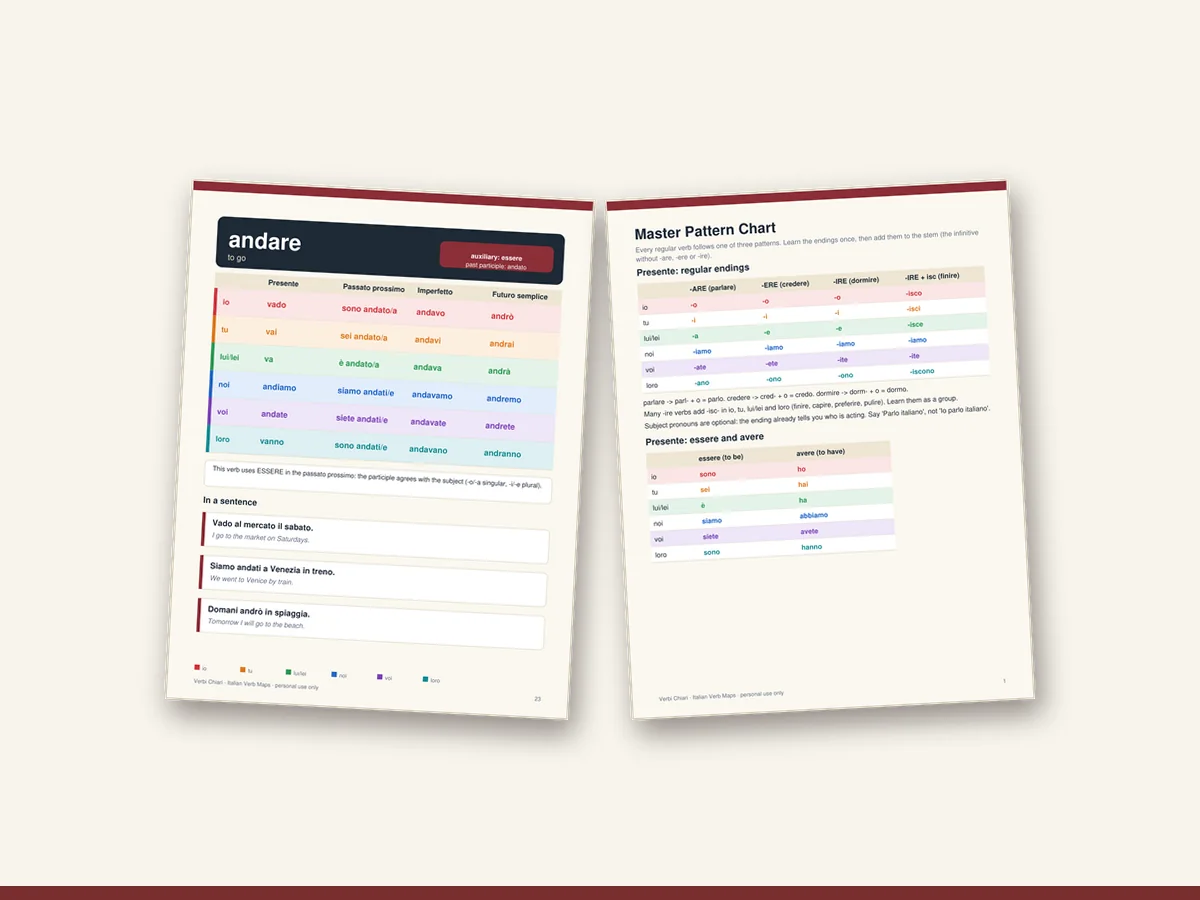
The grammar printables worth your ink are the ones you consult every day: a pattern chart, verbs on single pages and a few vocabulary sheets. Anything else tends to sit in a drawer. This guide describes a small, practical set, how to print and organize it, and how Verbi Chiari · Italian Verb Map Bundle fits that set.
Why print at all
A screen is great for reading and poor for studying. On paper you can write on the page, spread three pages side by side, tape one to the fridge and cover half with your hand. The act of picking up a page is itself a cue to study, and it takes no notifications.
The five printables that matter
| Printable | What it does | How often you use it |
|---|---|---|
| Start Here guide | Shows the order and the method | Once, then occasionally |
| Master pattern chart | Shows -are, -ere, -ire, essere and avere | Daily at first |
| Verb maps | One verb, four tenses, three sentences | Daily |
| Vocabulary sheets | Words by theme | By situation |
| Your own page | Notes and sentences | Daily |
Notice what is not on the list: long grammar essays and test papers. Those belong in a textbook.
The master pattern chart
If you only print one sheet, make it this one. It puts the three regular families side by side, plus essere and avere:
| Group | Example | io | tu | lui/lei | noi | voi | loro |
|---|---|---|---|---|---|---|---|
| -are | parlare | parlo | parli | parla | parliamo | parlate | parlano |
| -ere | vedere | vedo | vedi | vede | vediamo | vedete | vedono |
| -ire | dormire | dormo | dormi | dorme | dormiamo | dormite | dormono |
| -ire (-isc-) | finire | finisco | finisci | finisce | finiamo | finite | finiscono |
Put it where you can see it while you do everything else with verbs.
The verb maps
One page per verb, with four tenses, color by person and three example sentences. Print them as you meet the verbs, not all at once. A good habit is to print four a week and use the front and back of each sleeve to hold the old pages.
The vocabulary sheets
Twenty themes, from food and travel to home and people. Print the ones you need for the next trip or the next conversation, and keep the rest as PDFs.
Printing tips
- Color helps. The person colors do real teaching. If you must print in grayscale, use highlighters.
- Paper. Standard office paper works. A heavier stock lasts longer for pages you handle daily.
- Layout. The pages are made to print on US Letter. Check the scaling in your print dialog and choose "actual size".
- Duplex. Not necessary, and it makes pages harder to lay side by side.
- Sleeves. A clear sleeve plus a dry-erase marker turns a page into a reusable worksheet.
How to organize the binder
- Front: Patterns. Start Here and the master chart.
- Section two: Learning. The verbs you are working on this week, no more than four.
- Section three: Known. Pages you can recite. Review monthly.
- Section four: Vocabulary. The sheets for your next situation.
- Back: Your pages. Sentences you wrote, mistakes you made, questions to ask.
This takes ten minutes to set up and keeps the stack from becoming a pile of paper.
A weekly rhythm
Monday, choose four verbs and move them to Learning. Tuesday to Friday, ten minutes each on one verb: read, cover, say, write. Saturday, review all four. Sunday, move one or two pages to Known and pick next week's set.
What printables cannot do
They cannot correct you, answer questions or give you pronunciation. Use them with listening, speaking and, if you can, a teacher or partner. They are a tidy base to work from.
The test of a good printable
Does it help you say something you could not say yesterday? Does it fit on one page? Can you find what you need in a few seconds? If so, it is worth the ink. A page that fails all three belongs in the recycling.
Three printable routines to try
The morning minute. Tape the master chart near the coffee machine. While the coffee brews, say the io and noi forms of one family aloud. It costs a minute and builds a habit you hardly notice.
The commute page. Slide the day's verb map into a sleeve or keep the PDF on your phone. On the bus, cover the forms and recall them one by one. If you get stuck, peek and try again.
The weekend rewrite. Take last week's verb pages and, on a blank sheet, write all four tenses from memory for io and noi. Compare. The mistakes you find are your plan for next week.
A word on quality
Not every printable is worth printing. Look for pages with clear type, enough white space to write in the margin and consistent layout from one page to the next. Consistency matters more than people think: when every verb sits in the same place, your eye learns where to look, and the study session starts faster. That is also why a set of one-verb pages is easy to organize: each page is a unit you can move, retire or review.
Sample setups for different learners
The commuter. Keeps the PDFs on a phone and prints only the master chart. Studies one verb per ride and writes sentences in a pocket notebook.
The evening-class student. Prints everything the teacher covers, sorts it into the binder and uses the verb maps to double-check homework. When the class reaches the passato prossimo, the maps for andare, fare and vedere are already worn at the corners.
The traveler. Prints the verb maps for twelve travel verbs and two vocabulary sheets, and leaves the rest. A slim folder fits in a daypack.
The heritage learner. Understands family conversations but hesitates when speaking. Uses the maps to turn what the ear knows into forms the mouth can produce, reading the three example sentences aloud each morning.
None of these needs all 60 maps at once. That is the advantage of a set made of single pages: you take what the moment requires and keep the rest in reserve.
Take a look at the print layout sample above, then see whether this small, focused set is the one you want beside your notebook.