Italian Verb Conjugation Worksheets You Can Print and Reuse
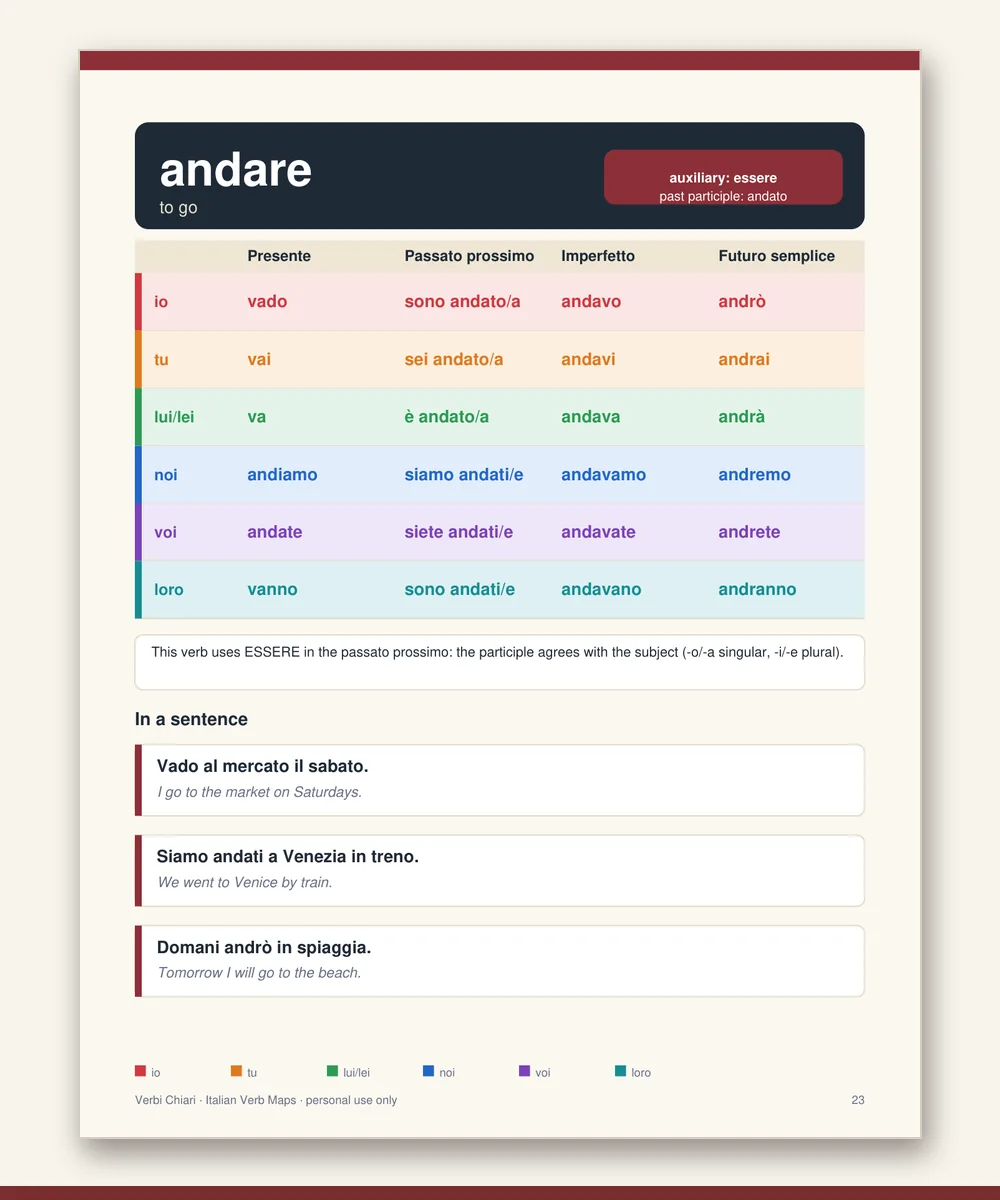
The best Italian verb conjugation worksheet is a clean verb page you can turn into practice in four different ways, each taking about ten minutes. Instead of buying a stack of worksheets that each drill one tense once, you print the page for a verb and reuse it. This guide shows the four methods, with real examples, using the verb pages in Verbi Chiari · Italian Verb Map Bundle.
Why drill sheets often disappoint
A typical conjugation worksheet gives you twelve sentences with a blank and the infinitive in brackets. You fill them in, check the answer key and move on. Two problems follow. You practice a single tense at a time, so you never see the verb as a whole. And the key tells you right or wrong without showing why.
Practice sticks when you see the same verb in all four tenses, say it aloud and use it in a sentence of your own. A verb page gives you all three.
Method 1: Cover and recall
This is the simplest and the one with the best return.
- Print the page for fare ("to do, to make").
- Fold or cover the columns so only the infinitive is visible.
- Say the io form of the four tenses from memory: faccio, ho fatto, facevo, farò.
- Uncover and check. Mark any slip with a pencil dot.
- Repeat with noi: facciamo, abbiamo fatto, facevamo, faremo.
Dots accumulate in the same places. Those are the forms to focus on tomorrow.
Method 2: The blank copy
Print the page twice. On the second copy, cover the verb forms with correction tape or just use a sheet of paper. Now write the forms in from memory, person by person, and check against the original.
With vedere the result might look like this:
| Person | Present | Passato prossimo | Imperfetto | Future |
|---|---|---|---|---|
| io | vedo | ho visto | vedevo | vedrò |
| noi | vediamo | abbiamo visto | vedevamo | vedremo |
| loro | vedono | hanno visto | vedevano | vedranno |
Writing slows you down just enough to notice the stem change in the future (vedr-) and the irregular participle visto.
Method 3: Sentences from the page
Every verb map includes three example sentences. Use them as a model, not a script. Take finire:
- "Finisco alle cinque." (I finish at five.)
- "Abbiamo finito la cena." (We finished dinner.)
- "Finirete presto?" (Will you finish soon?)
Now write three of your own with the same verb and a different subject: "Marta finisce il lavoro", "Ho finito il libro", "Finiranno domani". The form is the same, and the content is yours. Sentences you invent are remembered far longer than sentences you copy.
Method 4: The color game
The verb maps give each person its own color. Use that for a quick drill. Cover the page and ask yourself: what color is loro? What does the present tense end in for that color? You are training your eye for the endings as a group, which is what lets you handle new verbs.
A quick test: write -o, -i, -a, -iamo, -ate, -ano on a card and match each to its person for parlare. Then do the same with -o, -i, -e, -iamo, -ete, -ono for vedere. The overlap is large, and that is the point.
A weekly plan using ten-minute sessions
| Day | Verb | Focus |
|---|---|---|
| Mon | essere | Present and passato prossimo, cover and recall |
| Tue | avere | Same, then three sentences of your own |
| Wed | andare | Blank copy, mind the auxiliary |
| Thu | fare | Cover and recall, then the color game |
| Fri | parlare | Blank copy plus sentences |
| Sat | Mixed | Pick three verbs, recall io and noi |
| Sun | Rest or listen | Hear the verbs in a song or a short video |
After four weeks you will have gone through twenty-odd verbs and repeated the most useful ones several times.
Making the pages reusable
- Sleeve and marker. A clear plastic sleeve and a dry-erase marker turn each page into endless worksheets.
- Highlighter for weak spots. Mark only the forms you got wrong last time.
- A folder of "known" and "learning". Move the page across when it feels easy.
- Print only what you need. There is no point in printing all 60 on day one. Start with ten.
What to look for in any worksheet set
Whatever you use, check that it shows the auxiliary for the passato prossimo, uses real sentences and lets you reuse the page. The bundle was designed with those three points in mind. It also has a Start Here guide that explains the order, and a master chart that shows how verbs group by ending.
Limits to keep in mind
These pages are a study aid and not a course. They will not correct your pronunciation, hold a conversation with you or cover the subjunctive. Pair them with listening and speaking, even if it is five minutes of reading sentences aloud.
A short example session
Say you picked prendere today. Read the page once: prendo, prendi, prende, prendiamo, prendete, prendono. Participle: preso, so ho preso. Imperfetto: prendevo. Future: prenderò. Cover everything, then say "Che cosa prendi?" aloud and answer: "Prendo un caffè." Close the page and write a sentence in the passato prossimo: "Ieri ho preso il treno." Total time: nine minutes, and you now own prendere a little more than yesterday.
Self-check after a month
At the end of four weeks, take a blank sheet and write the present tense of ten verbs, then the passato prossimo with helper for six of them. Compare with your pages. Count the correct forms, and write the number at the top with the date. A month later, repeat. The number is a plain way to see progress without any exam, and it tells you where to put your next ten-minute sessions.
Working with a partner
If you have a study partner, the same pages double as a game. One person says an infinitive and a person, the other answers with the four tenses. Swap after five verbs. Add a rule: every answer must come with a sentence. It takes ten minutes, costs nothing and, because someone is listening, makes you say the forms aloud.
Check the sample page above, picture it in your folder and decide whether 60 pages like it would give you ten-minute practice for the next several months.