Italian Verbs for Beginners: Where to Start and What to Print
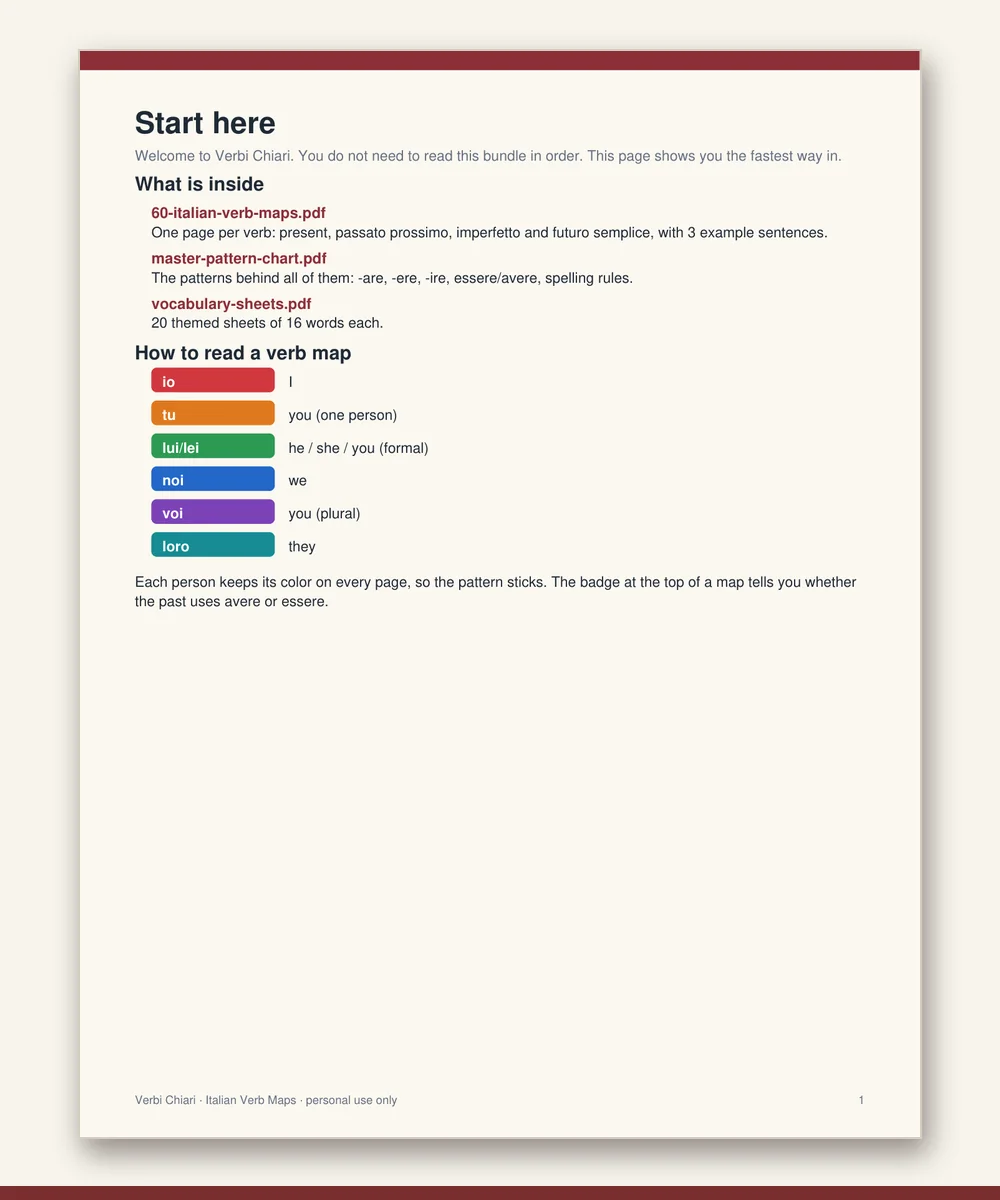
If you are starting from zero, the fastest useful Italian is built on about ten verbs, learned in the right order. You do not need a full grammar course to say who you are, what you want and where you are going. This guide gives you the order, the first sentences and the printable pages to keep next to you, with Verbi Chiari · Italian Verb Map Bundle as the toolkit.
The mindset: a few verbs, many sentences
Imagine a first day in Rome. You say "Sono americano". You ask "Dov'è la stazione?" You order "Vorrei un caffè". You confirm "Va bene". Each of these uses a verb: essere, volere, andare. A beginner who knows six or seven verbs already has the skeleton of most basic exchanges.
So the plan is not "learn Italian verbs"; it is "learn these specific verbs, one at a time, until they work".
Step 1: Essere and avere
Everything starts here.
| essere (to be) | avere (to have) | |
|---|---|---|
| io | sono | ho |
| tu | sei | hai |
| lui/lei | è | ha |
| noi | siamo | abbiamo |
| voi | siete | avete |
| loro | sono | hanno |
With these you can say: "Sono stanco." "Siamo a Roma." "Ho fame." "Hai una penna?" Practice each form aloud in a short sentence. Do not move on until sono, sei, è and ho, hai, ha feel automatic.
Step 2: Andare and fare
| andare (to go) | fare (to do, to make) | |
|---|---|---|
| io | vado | faccio |
| tu | vai | fai |
| lui/lei | va | fa |
| noi | andiamo | facciamo |
| voi | andate | fate |
| loro | vanno | fanno |
"Vado al lavoro." "Andiamo al mare." "Che cosa fai stasera?" "Faccio la spesa." Two verbs, dozens of everyday sentences.
Step 3: Want, can, must
Volere, potere and dovere work with another verb: "Voglio mangiare." "Posso entrare?" "Dobbiamo partire." Learn the present first: voglio, vuoi, vuole, vogliamo, volete, vogliono; posso, puoi, può, possiamo, potete, possono; devo, devi, deve, dobbiamo, dovete, devono.
Step 4: The three regular families
Now the rule-based verbs. One example per family:
| parlare | vedere | finire | |
|---|---|---|---|
| io | parlo | vedo | finisco |
| tu | parli | vedi | finisci |
| lui/lei | parla | vede | finisce |
| noi | parliamo | vediamo | finiamo |
| voi | parlate | vedete | finite |
| loro | parlano | vedono | finiscono |
Learn these three and you can conjugate dozens: mangiare, comprare, lavorare; prendere, scrivere, leggere; capire, preferire, pulire. The master pattern chart shows them next to each other so the similarities jump out.
Step 5: Talk about yesterday
When the present feels comfortable, add the passato prossimo: helper plus participle. "Ho mangiato." "Ho finito." "Sono andata a Roma." The only decision is avere or essere, and the verb maps show the right one on every page.
What the bundle gives a beginner
- A Start Here guide that shows how to use the maps and in what order.
- 60 verb maps, each with four tenses, color by person and three short sentences.
- A master pattern chart that shows the rules of the three families plus essere and avere.
- 20 themed vocabulary sheets, so you have words to put with the verbs.
Everything is a PDF. Print what you are using this week and leave the rest on your device.
A first week
| Day | What to do | Time |
|---|---|---|
| 1 | Read Start Here. Learn sono, sei, è | 10 min |
| 2 | Ho, hai, ha. Make four sentences | 10 min |
| 3 | Vado, vai, va. Say where you go | 10 min |
| 4 | Faccio, fai, fa. Say what you do | 10 min |
| 5 | Review all four, cover and recall | 10 min |
| 6 | One regular verb: parlare | 10 min |
| 7 | Rest, listen to Italian, notice the verbs | 5 min |
Seventy minutes in total and you have seven verbs ready.
Mistakes beginners can skip
- Dropping subject pronouns too early or too late. Italian often drops io and tu, because the ending shows the person. Parlo means "I speak". You will see that in the maps.
- Translating word by word. "I am hungry" becomes ho fame, literally "I have hunger".
- Skipping the helper. In the past, essere or avere is a decision you must make each time.
Honest limits
This is a study aid. It cannot give you conversation or fix your accent, and it will not make you fluent by itself. It will, however, give you the verbs that carry most basic sentences in a form you can see, print and review. For the subjunctive and other tenses, you will need more material later.
Reading a verb map as a beginner
When you open a verb map for the first time, do not try to take in everything. Look at the infinitive and its meaning at the top. Then read down the present column only, in order: io, tu, lui/lei, noi, voi, loro. Read the first example sentence. That is a full first pass and it takes about two minutes.
On the second visit, add the passato prossimo column. Notice the helper at the front. On the third, add the future. The imperfetto can wait until you feel comfortable telling stories about the past. Treat each page as a building you visit several times, not a test you must pass at once.
When you feel stuck
Everyone hits a wall around the second or third week, when forms start to blur. The cure is smaller steps, not more hours. Go back to essere and avere. Say them ten times. Then pick a single regular verb and say its six present forms. A solid base returns quickly, and the confusion tends to lift after a day or two of narrow, steady practice.
Read the first Start Here page above and see whether the order feels right for you. If it does, you can print the first four verbs today.